How Much Is Health Insurance in New York? 2026 Costs
The health insurance cost ny residents actually pay bears little relation to the price on the plan. Full price for an individual marketplace plan runs roughly $647 to $1,088 a month in 2026 — and almost nobody pays that. Below 200% of the federal poverty level the Essential Plan costs nothing per month with no deductible, and above it a tax credit cuts the premium sharply. This page sets out what each route actually costs, and why New York’s sticker price is high while its real cost frequently is not.

What brings you here today?
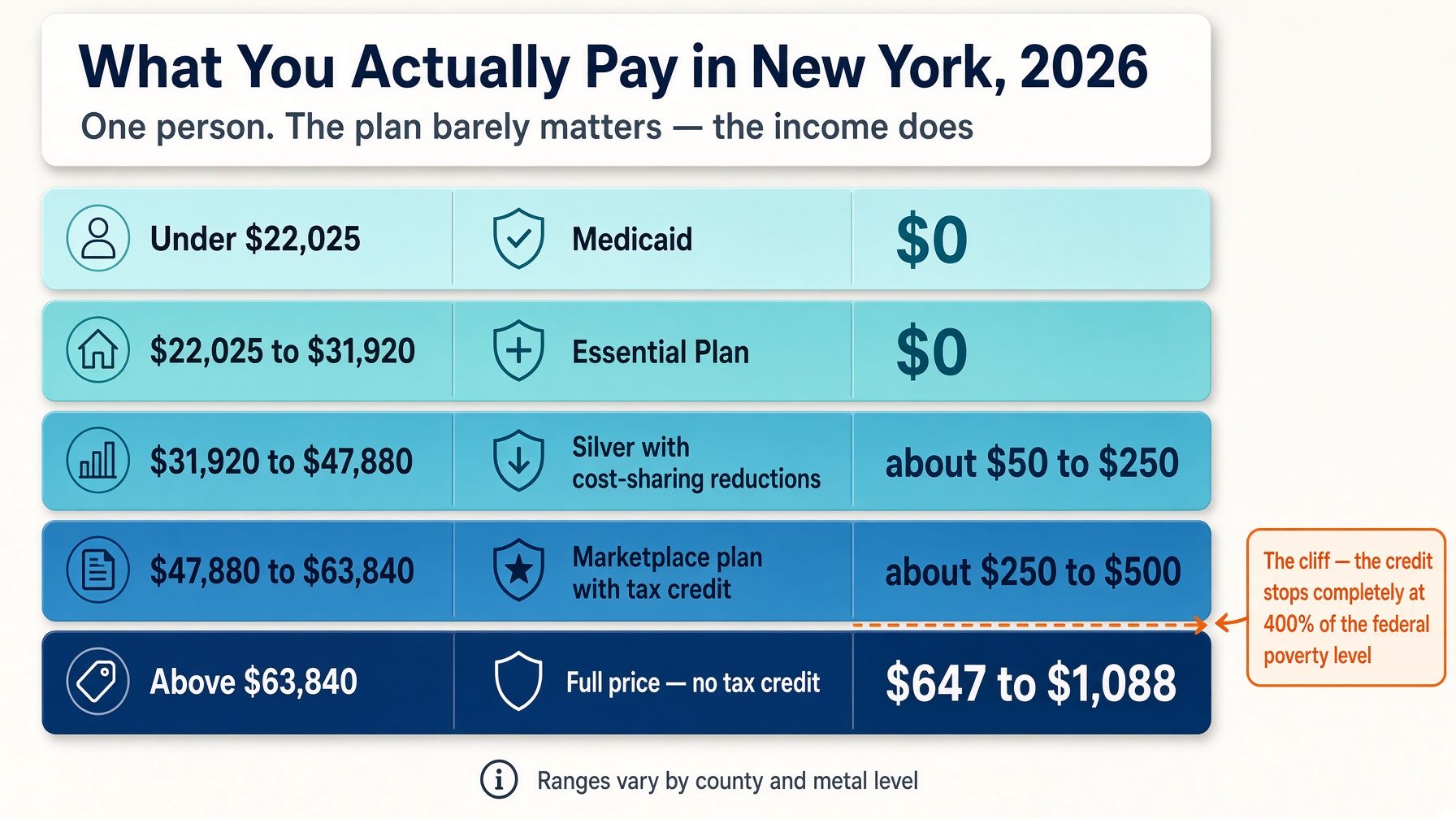
What You Actually Pay, by Income
Income decides the health insurance cost ny residents face, far more than the plan does. The same 40-year-old in the same county pays nothing, a few hundred, or over a thousand a month depending entirely on what they earn.
2026 figures. Ranges vary by county and metal level. Full thresholds on the income eligibility page.
One threshold matters more than any other to the health insurance cost ny buyers face. The jump at $63,840 is the one to know about. That is 400% of the federal poverty level, and above it the tax credit stops completely with no taper. A household earning one dollar more than the threshold pays full price. The enhanced subsidies that removed that cliff expired at the end of 2025, so it is back for 2026. And the figure driving your health insurance cost ny side is not your salary. The marketplace asks what you expect to earn this calendar year, after business expenses if you are self-employed. Someone who starts a job in September has earned far less across the year than their salary suggests.
The Cheapest Coverage in New York
For most people it is the Essential Plan — $0 a month, no deductible, dental and vision included, for incomes up to 200% of the federal poverty level. Below 138% it is Medicaid, also free. Neither has an enrollment deadline. Above those thresholds, Bronze has the lowest premium and the highest cost when you actually use care.
The lowest health insurance cost ny offers splits into two different questions, and people usually ask the wrong one.
Cheapest monthly
Bronze, if you are paying full price. It also carries the highest deductible, so a single hospital visit costs more than a year of the difference.
Cheapest overall
Almost always Silver if you receive a tax credit, because New York attaches cost-sharing reductions to Silver plans only. Those cut the deductible and out-of-pocket maximum without raising the premium — so a subsidised Silver plan can cost less per month and less at the point of care than Bronze.
Someone in Westchester earning $35,910 compares two plans. Bronze quotes $180 a month after the credit; Silver quotes $230. Bronze looks like the obvious answer at $600 a year cheaper.
At that income the Silver plan carries cost-sharing reductions: the deductible drops to a few hundred dollars where Bronze sits in the thousands, and the out-of-pocket maximum falls with it. One outpatient procedure erases the annual premium difference several times over.
The cost-sharing reductions attach to Silver and to nobody who does not take Silver. Choosing Bronze to save $50 a month forfeits them entirely, which is the most expensive $600 many New Yorkers save.
Catastrophic plans are cheaper still but restricted — generally under 30, or with a hardship exemption — and the tax credit cannot be applied to them. For anyone eligible for a credit they are almost never the better answer.
Why New York Looks Expensive
Community rating. New York does not allow insurers to charge more for age or health history, so everyone in a rating region pays the same premium for the same plan. That makes the state expensive for the young and healthy and unusually good value for everyone else.
Most states let insurers charge a 64-year-old up to three times what they charge a 21-year-old. New York does not permit that at all, which is the single biggest driver of health insurance cost ny headlines. Research on state premium comparisons consistently ranks New York among the most expensive individual markets in the country. Those rankings are calculated on the unsubsidised premium for a benchmark age, which is precisely the number almost nobody here pays.
The consequence for a 25-year-old
A premium well above what they would pay in most of the country, which is why New York appears near the top of every national cost comparison.
The consequence for a 60-year-old
The opposite. They pay the same as the 25-year-old, where elsewhere they would pay triple. For older buyers New York is among the better states in the country, and the national comparisons never say so.
And nobody is charged more for being ill
No medical underwriting, no surcharge for a pre-existing condition, no higher rate after a bad claims year. That protection is priced into everyone’s premium, which is precisely why the headline number is high.
The rates themselves are reviewed before they take effect. According to the New York State Department of Financial Services, approved 2026 rates came in substantially below what insurers requested — individual market increases were reduced by 47.4% from the requested figures, saving consumers around $148 million.
See your actual price, not the sticker price
Enter your income and county to see every New York plan with the tax credit already applied — about two minutes, no commitment. Or talk it through with a licensed New York agent at no charge.
Does Where You Live Change the Price?
Between regions, yes — New York sets rating regions and downstate generally costs more. Within New York City, no. The premium is identical across all five boroughs. What differs between boroughs is which hospitals are in network, not what you pay.
That borough point catches people out constantly, because it runs against intuition. A Bronx resident and a Manhattan resident buying the same plan from the same insurer pay the same premium.
What actually differs is the network
A plan built around a Manhattan hospital system may have thin coverage in Staten Island, and the reverse. Choosing on borough is choosing on the wrong variable — the question is whether your doctors participate. More on how NYC networks differ.
Between regions the difference is real but modest
Upstate regions generally price below downstate ones, reflecting local provider costs. It is not the difference between affordable and unaffordable, and it is dwarfed by the effect of income.
Your region follows your home address
, not where you work. Someone living in Rockland and commuting to Manhattan is priced on Rockland.
Getting an Actual Quote
A quote takes about two minutes and needs three things: your expected income for the year, your age, and your county. It commits you to nothing, and it is the only way to replace the ranges on this page with your own number.
Everything above is a range because the health insurance cost ny residents face genuinely swings that widely. The figures that matter are yours.
Expected income for the calendar year
, not last year’s and not your salary. For self-employed income use the net figure after business expenses — that distinction alone moves a great many people into the Essential Plan range.
Household size as it appears on your tax return
Yourself, a spouse if filing jointly, and anyone you claim as a dependent.
Your county
, which sets the rating region and therefore the baseline health insurance cost ny applies to you, and the benchmark plan your credit is calculated against.
What you get back is every plan available to you with the credit already applied — not a sticker price you then have to work out subsidies against. If the number looks wrong, it usually means the income estimate needs revisiting rather than the plan.
What Changed for 2026
Two changes, and both raised costs for specific groups. The enhanced subsidies that removed the 400% income cliff expired at the end of 2025, and the Essential Plan income ceiling dropped from 250% to 200% of the federal poverty level on 1 July 2026.
Both changes moved the health insurance cost ny households pay. The cliff is back. From 2021 to 2025, households above 400% of the federal poverty level still received a partial credit. That ended. In 2026 the credit stops completely at $63,840 for one person, with no taper.
And around 450,000 New Yorkers lost the Essential Plan
When the state returned the programme to Basic Health Program authority on 1 July, the 200–250% income band was eliminated. Those households now buy a subsidised marketplace plan instead — still heavily discounted, but no longer free. What changed and what you qualify for now.
What did not change
Community rating and the ban on medical underwriting are untouched. Nobody in New York pays more for their age or their health, and that remains true whatever else moves.
Frequently Asked Questions
How much is health insurance in NY per month?
Full price for an individual marketplace plan runs roughly $647 to $1,088 a month in 2026 depending on metal level and county. Almost nobody pays that. After the premium tax credit most people pay a fraction of it, and below 200% of the federal poverty level the Essential Plan costs nothing per month.
Why is health insurance so expensive in New York?
New York uses community rating, so premiums do not vary by age or health history. That makes the state expensive for young and healthy buyers and comparatively good value for older people and anyone with a condition. The sticker price is high; what most people actually pay is not.
What is the cheapest health insurance in New York?
For most people it is the Essential Plan, which costs $0 a month with no deductible for incomes up to 200% of the federal poverty level. Below 138% it is Medicaid, also free. Above those thresholds, a Bronze marketplace plan has the lowest premium but the highest costs when you use care.
Does health insurance cost more in NYC than upstate?
Yes, but less than people expect. New York sets rating regions and premiums vary between them, with downstate generally higher. Within New York City the premium is identical across all five boroughs — what differs between boroughs is which hospitals are in network, not the price.
How much is health insurance for one person in New York?
It depends entirely on income rather than on the plan. Earning under $22,025 means Medicaid at no cost. Between $22,025 and $31,920 means the Essential Plan, also at no cost. Above that, a tax credit reduces the premium on a sliding scale up to $63,840.
How do I get a health insurance quote in New York?
Enter your income, age and county and you will see every plan available to you with the tax credit already applied. A quote takes a couple of minutes and does not commit you to anything. A licensed New York agent can also run it with you by phone at no cost.
Did health insurance get more expensive in New York for 2026?
For some people, yes. The enhanced subsidies that removed the 400% income cliff expired at the end of 2025, so households above that threshold now pay full price. And the Essential Plan income ceiling dropped from 250% to 200% of the federal poverty level on July 1, 2026.
Related New York Health Insurance Resources
The thresholds that decide what you pay, for every programme
New York Essential Plan$0 a month, no deductible, dental and vision included
NY Health Insurance MarketplaceHow the state marketplace works and how credits are applied
Health Insurance in NYCWhy the price is the same in every borough and the network is not
NY Enrollment Dates & DeadlinesWhen you can buy, and which programmes have no deadline at all
Self-Employed Health InsuranceWhy net income rather than gross decides what you pay
Two minutes replaces every range on this page
Enter your income and county and see your own number, with the tax credit applied. Or talk it through with a licensed New York agent. Free either way.