New York Income Limits 2026: Medicaid, Essential Plan and Marketplace Subsidies
Every health coverage program in New York is decided by one number — your household income measured against the federal poverty level. This page gives the 2026 figures for Medicaid, the Essential Plan, Child Health Plus and marketplace premium tax credits, in full, by household size. It also covers what actually counts as income, who counts in your household, and what changes if your earnings shift during the year.

What brings you here today?
Every 2026 Income Limit in One Chart
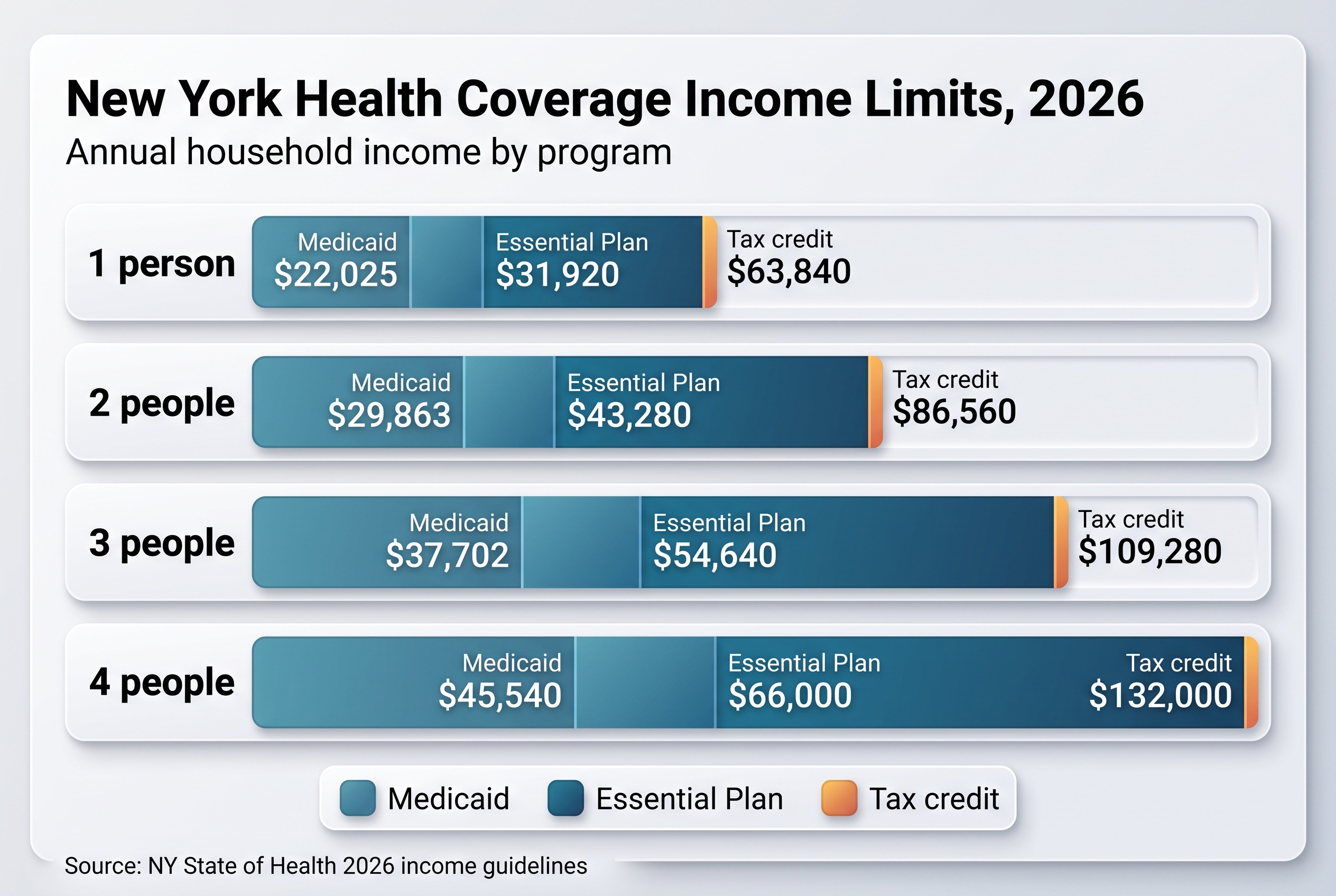
New York runs four coverage programs off a single income scale. Medicaid covers adults to 138% of the federal poverty level, the Essential Plan to 200%, Child Health Plus on a sliding premium to 400%, and marketplace tax credits from 138% to 400%. For one person in 2026, those thresholds are $22,025, $31,920 and $63,840.
2026 annual income figures, based on the federal poverty guidelines NY State of Health uses for eligibility. Add $5,680 to the 100% poverty line for each household member beyond eight.
These figures changed for 2026
The poverty guidelines published each year by the U.S. Department of Health and Human Services rise with inflation, so every threshold on this page is higher than its 2025 equivalent. The 100% poverty line for one person moved from $15,650 to $15,960, an increase of about 2 percent. Separately, the Essential Plan ceiling dropped from 250% to 200% of poverty on July 1, 2026 — a change to the programme itself rather than to the guidelines.
The scale of these programmes is worth keeping in mind when reading the thresholds. According to New York State Department of Health figures, Medicaid covers about 6.5 million New Yorkers, and roughly 1.3 million more are enrolled in the Essential Plan under Basic Health Program authority. Between them the two programmes cover close to two in five state residents, which is why a shift of a few percentage points in an income limit moves hundreds of thousands of people.
New York Medicaid Income Limits 2026
Medicaid in New York uses different thresholds depending on who is covered. Adults aged 19 to 64 qualify up to 138% of the federal poverty level. Children aged 1 to 18 qualify to 154%, young adults aged 19 and 20 living with a parent to 155%, and pregnant people and infants under one year to 223%.
2026 annual income figures. Adults aged 65 and over, and people who are blind or disabled, are assessed under different Medicaid rules that also consider assets.
Medicaid has no enrollment deadline. If your income qualifies, you can apply at any point in the year through NY State of Health, and coverage generally starts the month you apply. A pregnancy raises the household count as well as the threshold, which is why the pregnancy column is so much higher — a pregnant person in a two-person household is assessed as three, a combination that moves many households into Medicaid who would otherwise sit above the adult limit.
Essential Plan Income Limits 2026
Essential Plan income eligibility runs from roughly 138% to 200% of the federal poverty level — $22,025 to $31,920 for one person in 2026. The upper limit dropped from 250% on July 1, 2026, when the Essential Plan 200-250 tier was eliminated. Coverage costs $0 a month with no deductible, and includes dental and vision.
Essential Plan income eligibility is assessed on the same figures for every tier. Tiers 3 and 4 apply to people who are not eligible for Medicaid despite low income, most often because of immigration status. NY State of Health assigns the tier automatically.
If you lost Essential Plan coverage on July 1, the deadline is August 30, 2026
Roughly 450,000 New Yorkers earning between 200% and 250% of poverty were moved off the Essential Plan when the tier closed. NY State of Health has set August 30, 2026 as the date by which they must enroll in a new plan. What changed and what you qualify for now.
Child Health Plus Income Limits 2026
Child Health Plus covers New Yorkers under 19 whose household income is too high for Medicaid. It is free below 222% of the federal poverty level and charges a monthly premium per child on a sliding scale above that, topping out at $60 per child between 350% and 400%.
2026 annual income figures. Above 400% of poverty, families can still buy Child Health Plus at the full plan cost.
Full premium tiers are published by NY State of Health. Child Health Plus has no income ceiling in the sense that matters — families above 400% can enrol by paying the full premium. There is also no enrollment deadline, and no waiting period for a child with a pre-existing condition.
Marketplace Tax Credit Income Limits 2026
Premium tax credits on a Qualified Health Plan run from 138% up to 400% of the federal poverty level — roughly $22,025 to $63,840 for one person in 2026. Below that range, Medicaid or the Essential Plan applies instead. Above it, no credit is available and the full premium applies.
The 400% ceiling matters more in 2026 than it did in recent years. The enhanced premium tax credits introduced in 2021 removed that cliff temporarily and expired at the end of 2025, so a household a dollar over the line now pays the unsubsidized price.
According to NY State of Health, an individual in New York City earning $35,910 — 225 percent of the poverty level — qualifies for a tax credit of $637 a month, which brings the benchmark Silver plan to $230 a month. In Erie County an individual at $39,900 qualifies for $295 a month, bringing the benchmark Silver plan to $286. The credit falls as income rises, which is why the same plan costs different amounts to different households.
New York layers a second form of help on top. Cost-sharing reductions apply to Silver plans for anyone receiving a premium tax credit, and New York extends them further up the income scale than federal rules require — the richer 87% variant reaches to 350% of poverty, and a 73% variant covers 350% to 400%. These lower the deductible and out-of-pocket maximum substantially without raising the premium, which is why Silver is often the strongest value in this range rather than Bronze.
See which program your income qualifies you for
A licensed New York agent checks your eligibility across every program, applies any tax credit, and shows the real monthly cost — at no charge.
What Counts as Income and Household Size
New York measures Modified Adjusted Gross Income, not take-home pay. It counts wages before tax, self-employment profit, unemployment benefits, Social Security and most retirement income. Household size is generally everyone on your federal tax return, and a pregnancy counts as more than one person.
Counted as Income
- Gross wages and salary
- Self-employment net profit
- Unemployment compensation
- Social Security retirement and disability benefits
- Pension and annuity income
- IRA and 401(k) distributions
- Rental income, interest and dividends
- Alimony from agreements finalised before 2019
Not Counted
- Child support received
- Supplemental Security Income
- Most veterans’ disability benefits
- Workers’ compensation
- Gifts and inheritances
- Proceeds from selling a home within the exclusion limits
- Alimony from agreements finalised in 2019 or later
Household size follows your tax filing. Include yourself, your spouse if you file jointly, and anyone you claim as a tax dependent — including a dependent who does not live with you, such as a child at college. A pregnant person counts as themselves plus the number expected, which frequently moves a household into a better band.
Eligibility uses expected income, not last year’s
New York assesses the income you expect for the current calendar year, so a mid-year change in earnings can move you between programs. Report changes to NY State of Health as they happen rather than waiting. If you receive a premium tax credit based on an income estimate that turns out to be too low, the difference is reconciled on your federal return and you may owe part of it back.
What Happens at the Boundaries
The thresholds are hard lines, and small income differences change which programme applies. A single New Yorker at $22,000 qualifies for Medicaid; at $22,100 they move to the Essential Plan. At $32,000 they move again, to a marketplace plan with a tax credit. Two practical points follow from that.
Being just over a line is rarely a disaster. Each step up carries its own help. Above Medicaid there is the Essential Plan at $0 a month. Above the Essential Plan there is a tax credit that covers most of the premium for someone earning in the low thirties, plus cost-sharing reductions on Silver plans. The genuine cliff is at 400% of poverty, and only there. Estimating income too low causes problems later, too — a household that underestimates and receives a larger credit than it was entitled to repays the difference at tax time. Estimating slightly high and reconciling in your favour is the safer error.
A single New Yorker in Syracuse expecting $31,900 for 2026 sits just under 200% of poverty. She qualifies for the Essential Plan: $0 premium, no deductible, dental and vision included.
Her neighbour expecting $32,100 is just over. He moves to a Qualified Health Plan with a premium tax credit. He pays a monthly premium where she pays nothing — but the credit covers most of it, and because he is under 350% of poverty his Silver plan carries the enhanced cost-sharing that cuts the deductible well below the standard version.
The gap between them is real but far smaller than the raw premium difference suggests. What would genuinely hurt is being wrong about which side of the line you are on, discovering it at tax time, and repaying a credit you were not entitled to.
If your income sits close to a threshold, the sensible approach is to run the numbers properly rather than guessing which side you fall on — the answer often depends on household composition as much as earnings.
Frequently Asked Questions
What is the income limit for Medicaid in New York for 2026?
For adults aged 19 to 64, New York Medicaid covers households up to 138% of the federal poverty level. In 2026 that is $22,025 a year for one person, $29,863 for two, $37,702 for three and $45,540 for four. Children, pregnant people and adults over 65 have higher limits.
What is the Essential Plan income limit in 2026?
200% of the federal poverty level, which is $31,920 a year for one person and $43,280 for two. The limit dropped from 250% on July 1, 2026, when the Essential Plan 200-250 tier was eliminated.
What income do I need to qualify for a health insurance subsidy in New York?
Premium tax credits are available from 138% up to 400% of the federal poverty level. For one person in 2026 that is roughly $22,025 to $63,840. Below that range you would generally qualify for Medicaid or the Essential Plan instead.
Is income measured before or after taxes?
New York uses Modified Adjusted Gross Income, which is close to your adjusted gross income before deductions and exemptions. It counts wages, self-employment income, unemployment benefits, Social Security and most retirement income. It does not count child support received, Supplemental Security Income, or most veterans’ benefits.
What counts as my household size?
Generally the people you claim on your federal tax return: yourself, your spouse if filing jointly, and your tax dependents. A pregnant person counts as more than one, which can move a household into a more favourable band.
What if my income changes during the year?
Report it to NY State of Health as soon as it happens. Eligibility is based on expected income for the year, so a change can move you between programs. Reporting late can mean owing back part of a premium tax credit at tax time.
What happens if my income is just over the Essential Plan limit?
You qualify for a Qualified Health Plan with a premium tax credit, and at that income the credit typically covers most of the premium. New York also adds cost-sharing reductions to Silver plans, which lower the deductible substantially compared with the standard version of the same plan.
Related New York Health Insurance Resources
What changed on July 1, who was affected, and the August 30 enrollment deadline
New York Essential PlanWhat the program covers, who qualifies, and how it compares with a marketplace plan
Essential Plan vs MedicaidHow the two programs differ on income limits, cost and coverage
Child Health PlusCoverage for New Yorkers under 19, premium tiers and how to enroll
NY Health Insurance MarketplaceHow the state marketplace works and how subsidies are applied to your premium
NY Enrollment DeadlinesOpen enrollment dates, special enrollment periods, and what happens if you miss one
Not sure which side of a threshold you fall on?
Compare New York plans and see your tax credit in about two minutes, or talk it through with a licensed New York agent. Free either way.