Essential Plan vs Medicaid in New York: 2026 Comparison
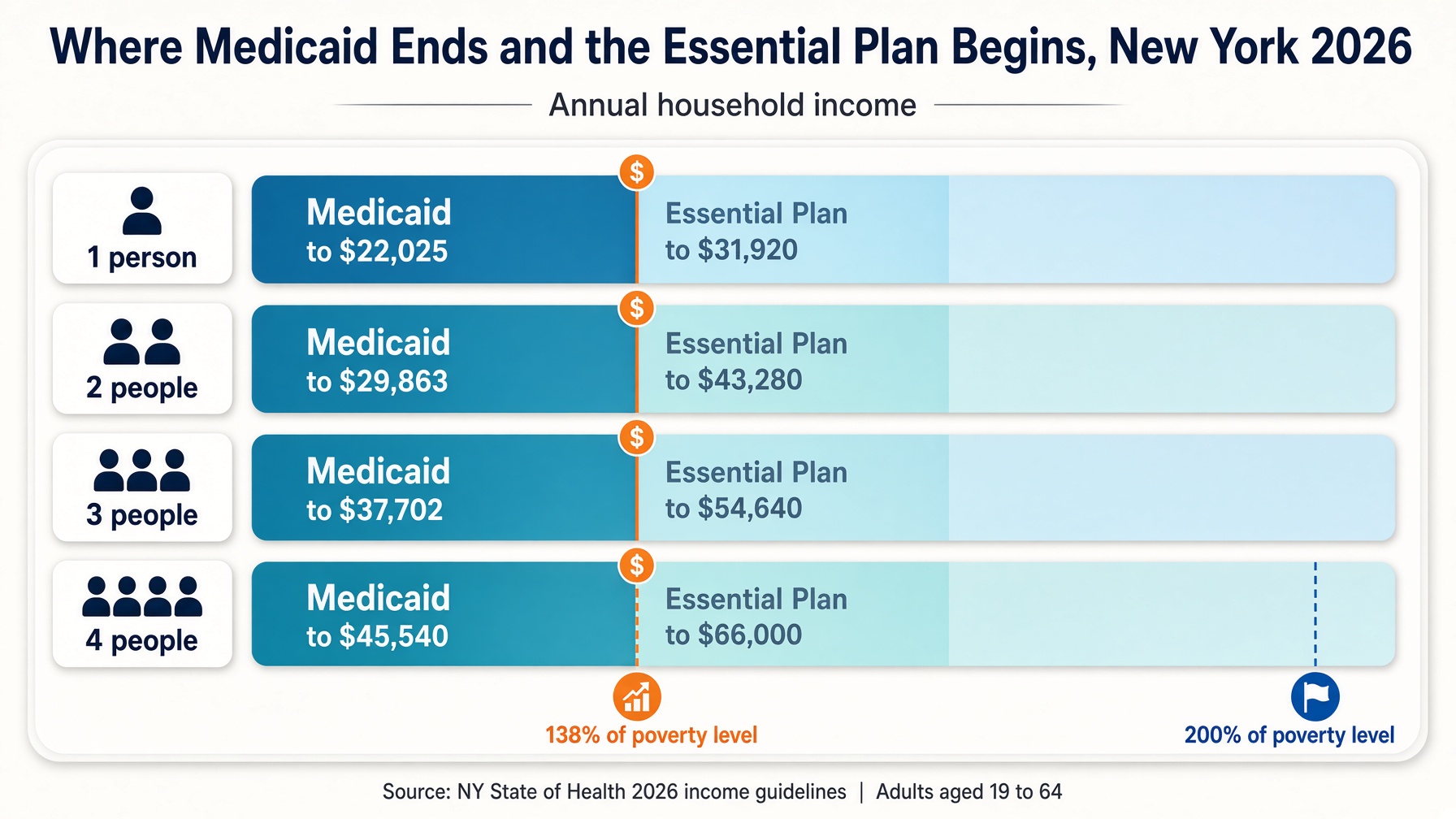
Essential Plan vs Medicaid is the most common question New Yorkers ask about free coverage, and the short answer is that they are separate programs divided by income. Medicaid covers adults earning up to about $22,025 a year; the Essential Plan picks up from there to $31,920. This page sets out how they differ on cost, coverage, enrollment and network, what happens when your income moves you from one to the other, and why some people whose income fits Medicaid end up on the Essential Plan instead.

What brings you here today?
Essential Plan vs Medicaid: The Short Answer
The Essential Plan is not Medicaid. They are separate programs with separate funding, separate rules and separate income limits. They resemble each other because both cost $0 a month, both include dental and vision, and both enroll year round — but Medicaid sits below the Essential Plan on the income scale and covers a little more.
2026 annual income figures for adults aged 19 to 64. Medicaid rules differ for people over 65, and for those who are blind or have a disability.
Which One Does Your Income Qualify You For?
You do not choose. NY State of Health assesses one application against every program and assigns whichever you are eligible for. Medicaid applies below 138% of the federal poverty level, the Essential Plan from 138% up to 200%, and a subsidized marketplace plan above that.
2026 annual figures. Children, pregnant people and adults over 65 have different Medicaid thresholds — see the full income limits page.
Pregnancy shifts things substantially. A pregnant person is counted as more than one household member, and the Medicaid threshold rises to 223% of poverty rather than 138%. That combination moves many households into Medicaid who would otherwise be assessed for the Essential Plan.
Essential Plan 4 vs Medicaid: Same Income, Different Program
Essential Plan tiers 3 and 4 cover incomes that would ordinarily qualify for Medicaid — under 138% of poverty, and under 100% respectively. People land there because their income fits Medicaid but their immigration status does not, most commonly during the five-year waiting period that applies to lawfully present immigrants.
This is the part of the comparison that confuses people most, and it is worth being precise about. If you search for Essential Plan 4 vs Medicaid, the honest answer is that they cover the same income band. The difference is eligibility on other grounds, not on money.
The practical effect is that New York keeps a large group covered who would be uninsured in most other states. According to the New York State Department of Health, about 1.3 million people are enrolled in the Essential Plan, and the tiers 3 and 4 population is a meaningful share of that.
Which Has Better Coverage?
Medicaid covers slightly more. Both include the ten essential health benefits plus adult dental and vision, and both cover pre-existing conditions from day one. Medicaid adds long-term care and non-emergency medical transportation, and charges no copays at all, where the Essential Plan has small ones.
For routine medical care — a doctor visit, a prescription, a scan, a hospital stay — the two are close enough that most members would not notice a difference. Research into state Basic Health Programs has generally found benefit packages close to Medicaid’s, and New York’s is no exception. The gaps show up in three places.
Long-Term Care
Nursing home care and home-based long-term services are Medicaid benefits. The Essential Plan does not cover them. For most working-age adults this is theoretical; for anyone managing a chronic condition that may need ongoing personal care, it is not.
Transportation
Medicaid pays for non-emergency medical transport to appointments. The Essential Plan does not. If getting to a specialist is a practical problem, that is a real difference.
Copays
Medicaid charges nothing. The Essential Plan charges small amounts on some services depending on tier — modest, but not zero.
Where they are identical
Both programs are delivered through private managed care plans, frequently the same insurers. Fidelis Care, Healthfirst, MetroPlus and others run both Medicaid managed care and Essential Plan products. If you move between the two, there is a reasonable chance you can stay with the same insurer and keep the same doctors — worth checking rather than assuming, but it happens often.
Find out which program your income qualifies you for
A licensed New York agent checks your eligibility across Medicaid, the Essential Plan and subsidized marketplace coverage, and explains what each would mean for you — at no charge.
What Happens When Your Income Crosses the Line
Moving between Medicaid and the Essential Plan is routine and does not create a coverage gap, provided you report the change. Report it to NY State of Health when it happens and eligibility is reassessed. Both programs cost $0, so crossing the 138% line does not change what you pay.
A raise that lifts a single New Yorker from $21,000 to $23,000 moves them from Medicaid to Essential Plan 2. The premium stays at zero, the deductible stays at zero, dental and vision stay included. What changes is small copays on some services, and the loss of long-term care and transport benefits they were probably not using. The consequential line is not that one — it is at 200% of poverty, where the Essential Plan ends and a marketplace plan begins, which is where a monthly premium appears for the first time, even after a tax credit.
$20,000 a year, single. Below 138% of poverty, so Medicaid. No premium, no deductible, no copays, and long-term care and transport are covered if ever needed.
$26,000 a year, single. Between 138% and 200%, so Essential Plan 1. Still no premium and no deductible, still dental and vision included. Small copays appear on some services; long-term care and transport drop away.
$35,000 a year, single. Above 200%, so a Qualified Health Plan with a premium tax credit. According to figures published by NY State of Health, an individual earning $35,910 in New York City qualifies for a credit of roughly $637 a month, bringing a benchmark Silver plan to about $230. Silver plans at this income also carry cost-sharing reductions that cut the deductible well below the standard version.
The step from Medicaid to the Essential Plan changes very little. The step above 200% is where cost genuinely enters, and it is still far below the unsubsidized price.
Since July 1, 2026 there is one more step in the sequence. The Essential Plan used to run to 250% of poverty; it now stops at 200%. Roughly 450,000 New Yorkers in the old 200-250 band moved to subsidized marketplace plans, and anyone affected has until August 30, 2026 to enroll. Details of that change are here.
Report income changes promptly
Eligibility is based on the income you expect for the year, not last year’s. If your earnings rise and you do not report it, you can end up enrolled in a program you no longer qualify for, which creates problems at renewal. Reporting takes a few minutes online or by phone, and there is no penalty for doing it.
How to Apply for Either
One application covers both. NY State of Health takes your income, household size and immigration status and returns whichever program you qualify for. Neither Medicaid nor the Essential Plan has an enrollment deadline, so you can apply in any month.
You will need proof of identity, New York residency and income, plus immigration documents where relevant. Pay stubs, a recent tax return, a lease or utility bill and a photo ID cover most situations, and uploading documents rather than mailing them shortens the decision considerably. According to NY State of Health, Medicaid covers about 6.5 million New Yorkers, and the Essential Plan roughly 1.3 million more — together close to two in five state residents, which is worth knowing if the application process feels like it was designed for a small group. It was not.
What a licensed agent can and cannot do
NYHealthInsurer.com does not enroll people into Medicaid or the Essential Plan — both go through NY State of Health directly. A licensed New York agent can confirm which program your income points to, explain what a subsidized marketplace plan would cost if you are above the Essential Plan limit, and walk you through the application. There is no charge.
Frequently Asked Questions
Is the Essential Plan the same as Medicaid?
No. They are separate programs with separate funding and separate income limits. Medicaid covers adults up to 138% of the federal poverty level; the Essential Plan covers roughly 138% to 200%. They look similar because both cost nothing per month and both enroll year round.
What is the difference between Medicaid and the Essential Plan?
The main difference is income. Medicaid covers adults earning up to $22,025 a year for one person in 2026; the Essential Plan covers roughly $22,025 to $31,920. Medicaid also covers long-term care and non-emergency medical transport, which the Essential Plan does not, and Medicaid has no copays at all where the Essential Plan has small ones.
Do I choose between the Essential Plan and Medicaid?
No. NY State of Health determines which program you qualify for from the income and household information on a single application. There is no option to pick one over the other.
What is Essential Plan 4 and how does it differ from Medicaid?
Essential Plan 4 covers people earning under 100% of the federal poverty level who are not eligible for Medicaid, most often because of immigration status. The income would qualify them for Medicaid; their status does not. Essential Plan 3 works the same way for the 100% to 138% band.
Is Medicaid managed care different from the Essential Plan?
Both are delivered through private managed care plans, often from the same insurers, so the member experience is similar. The difference is in what each program covers and who funds it, not in how care is delivered day to day.
What happens if my income rises above the Medicaid limit?
You move to the Essential Plan, which also costs nothing per month. Report the change to NY State of Health and it will reassess your eligibility. There is no gap in coverage if you report promptly.
Which one has better coverage?
Medicaid covers slightly more, including long-term care and non-emergency medical transportation, and has no copays. For routine medical care the two are close, and both include adult dental and vision and cover pre-existing conditions from day one.
Related New York Health Insurance Resources
Full charts for Medicaid, the Essential Plan, Child Health Plus and marketplace tax credits
New York Essential PlanWhat the program covers, who qualifies, and why it costs nothing per month
Essential Plan 200-250 EndedWhat changed on July 1, who was affected, and the August 30 enrollment deadline
Child Health PlusCoverage for New Yorkers under 19, premium tiers and how to enroll
Essential Plan CarriersWhich insurers offer the plan and where each one operates across New York
NY Health Insurance MarketplaceHow the state marketplace works and how subsidies are applied to your premium
Still not sure which one applies to you?
Check your eligibility in about two minutes, or talk it through with a licensed New York agent. Free either way.