Healthy NY in 2026: Who Can Still Get It, and What Replaced It
Healthy ny insurance still exists, and the answer most people need is that it stopped covering individuals and sole proprietors on 1 January 2014. If you are searching for it as a person rather than as an employer, the programme has not been available to you for twelve years — and what replaced it is better. This page covers who can still get Healthy NY, the 2026 wage level, and exactly what an individual should look at instead.

What brings you here today?
If You Are an Individual or Sole Proprietor
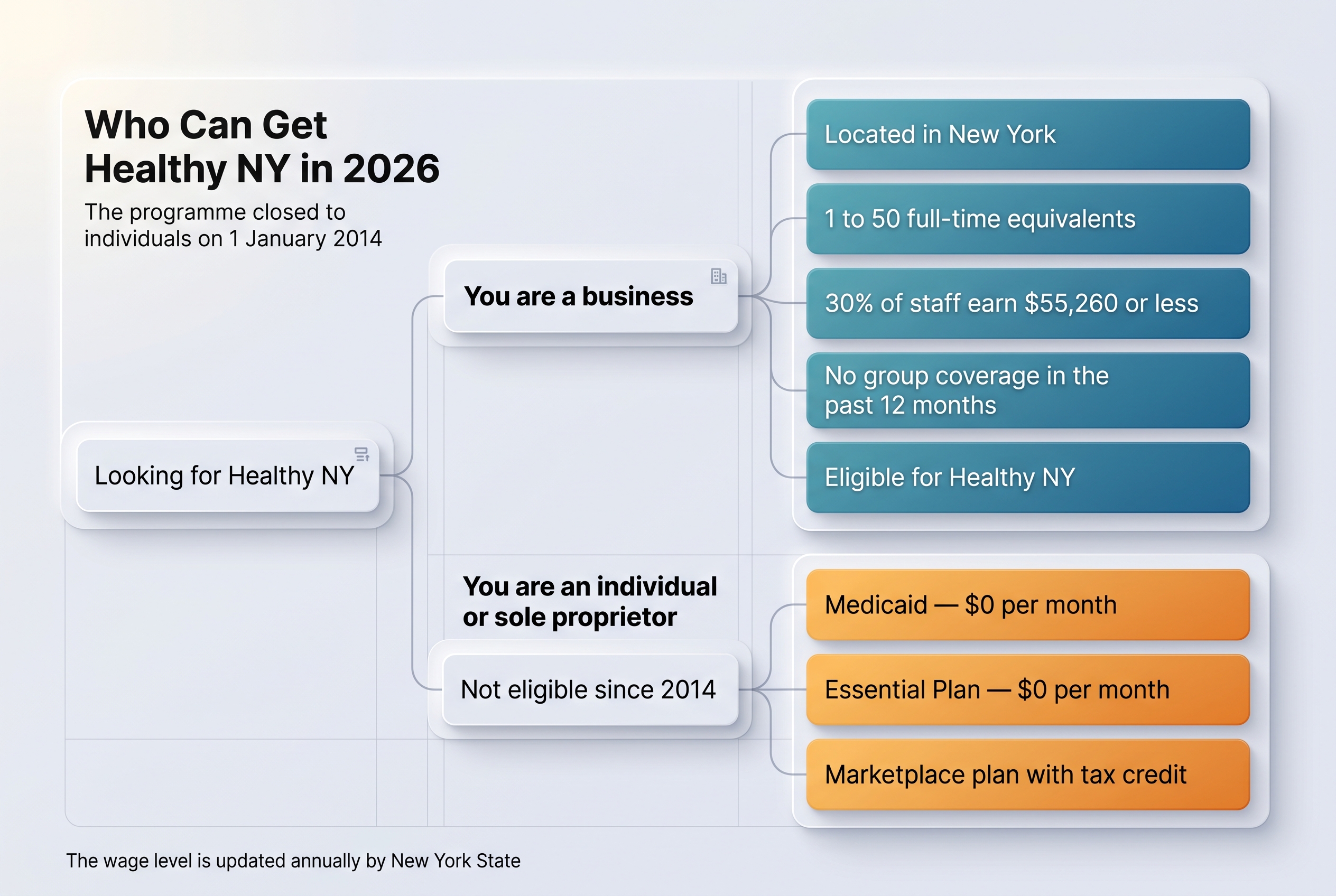
Healthy NY closed to you on 1 January 2014. The New York State Department of Financial Services directs individuals and sole proprietors to NY State of Health instead — and what is available there is more comprehensive than Healthy NY ever was, and frequently free.
Searches for healthy ny insurance are the single most common reason people arrive at this page, so the answer belongs first rather than buried.
2026 figures for a household of one. Full charts on the income eligibility page.
The Essential Plan is the closest successor to healthy ny insurance
It is better than what it replaced. No monthly premium, no deductible, and dental and vision included — where Healthy NY was a high-deductible product people paid for. If your income is at or below 200% of the federal poverty level, that is where to look.
Medicaid, the Essential Plan and Child Health Plus enrol year round
There is no deadline and no open enrollment window to miss.
If you are self-employed with no employees, the same applies — and the self-employed guide covers how the tax credit is calculated on net rather than gross income.
Who Qualifies in 2026
Four rules, and all four must hold. The business must be in New York, have had 1 to 50 full-time-equivalent employees over the previous calendar year, have at least 30% of employees earning $55,260 or less, and must not have provided group health insurance in the past 12 months.
The wage level is set by the New York State Department of Financial Services and updated annually against the federal poverty guidelines. Health plans apply the 2026 figure to coverage beginning on or after 1 January 2026.
According to programme guidance published by the New York State Department of Financial Services, the wage level has been updated every year since 2021, most recently in October 2025. Research on small-employer coverage consistently reports that firms below fifty employees have the lowest offer rates of any group, which is the gap healthy ny insurance was created in 2000 to close.
The prior-coverage rule is the one that disqualifies most businesses
, and it is not obvious. Healthy NY exists to bring in employers who do not currently offer insurance, so having offered it recently rules you out. The threshold is specific. A business counts as having provided coverage if it arranged comprehensive insurance — both hospital and medical — and contributed more than $50 per employee per month, or more than $75 in Bronx, Kings, Nassau, New York, Orange, Putnam, Queens, Richmond, Rockland, Suffolk and Westchester counties. Two consequences follow, and both work in an employer’s favour more often than expected.
Two consequences follow from that rule, and both work in an employer’s favour more often than expected.
Limited-benefit coverage does not count
If what you offered included only medical or only hospital benefits rather than both, your business may still be eligible.
Employees covered elsewhere do not count against you
Staff on a spouse’s plan or on Medicare still count toward the 50% participation requirement even though they are not enrolling. A five-person business where three have other coverage and two want Healthy NY generally qualifies.
What Healthy NY Covers
All ten essential health benefits — inpatient and outpatient hospital care, physician services, maternity, preventive care, diagnostics, mental health, chiropractic, prescription drugs, ambulance and emergency services. It is comprehensive on what it covers, and high-deductible by design on what you pay.
The coverage under healthy ny insurance is not the limitation. The cost structure is.
Healthy NY plans are high-deductible
That is the mechanism by which premiums are reduced — the employer and employee pay less monthly and more at the point of care. For a workforce that uses little care it can work well; for one with ongoing medical needs it frequently does not.
Premiums are filed by county and by carrier
DFS publishes approved healthy ny insurance rates for every county, and the same programme costs different amounts depending on where the business sits and which insurer writes it.
Participating insurers vary by region
Not every carrier offers Healthy NY everywhere, and the list changes between plan years.
Find out which route applies to you
Whether you are an employer checking the four rules or an individual who has just learned Healthy NY closed in 2014, a licensed New York agent can tell you what is actually available — at no charge.
Healthy NY or a Standard Small-Group Plan?
Worth comparing rather than assuming. Healthy NY reduces premiums through a high deductible and comes with restrictive rules; a standard small-group plan has none of those restrictions and New York’s community rating already keeps small-group pricing predictable.
Three of those points decide most applications.
The prior-coverage rule is what makes this a genuine choice rather than an obvious one
An employer who has never offered insurance can consider both. An employer who offered coverage last year and dropped it cannot use Healthy NY at all, whatever the price comparison would have shown.
Community rating narrows the gap between healthy ny insurance and standard cover
Small-group premiums here do not vary by employee age or health, so a standard plan is more predictable than it would be in most states. The saving from Healthy NY is real but it comes out of the deductible rather than out of thin air.
Plan type matters if your staff value out-of-network access
Standard small-group coverage in New York includes PPO options; Healthy NY does not. That is one of the few genuine product differences rather than a pricing one. The full small-group picture is here.
A Utica joinery with eight employees, six of them earning under the wage level, has never offered health insurance. Both routes are open.
Healthy NY quotes lower monthly premiums with a substantial deductible. A standard Bronze small-group plan quotes slightly higher premiums with a comparable deductible and a wider carrier choice; a Silver plan costs more monthly and considerably less at the point of care.
Which wins depends on how much care the staff actually use — and on whether the Small Business Health Care Tax Credit applies, which can return up to half the employer contribution either way. That credit is the number most owners never calculate, and it frequently matters more than the choice between the two programmes.
Applying
You apply through a participating insurer rather than through the state, using the DFS Healthy NY application. The eligibility conditions are checked at application and again at each renewal, so a business that grows past 50 full-time equivalents or improves its wage profile can lose eligibility.
What to have ready when applying for healthy ny insurance.
A wage census
You need to show that at least 30% of employees earn $55,260 or less. This is the figure most applications get returned on, so calculate it before applying rather than estimating.
Confirmation of no prior coverage
A statement that the business has not provided group health insurance in the previous 12 months, or has contributed below the $50 and $75 thresholds if it arranged something limited.
Your full-time-equivalent count for the prior calendar year
Part-time hours aggregate, so this is not simply a headcount.
Recertification
Eligibility is rechecked at renewal. Losing it does not leave you uninsured — it moves you to standard small-group coverage — but it is worth anticipating rather than discovering.
An agent can complete the census and eligibility check before an application is submitted, which avoids a declined application on record.
Frequently Asked Questions
Does Healthy NY still exist?
Yes, but only for small businesses. The New York State Department of Financial Services still oversees the programme and updates its wage level every year. Since January 1, 2014 it has not covered individuals or sole proprietors, who buy through NY State of Health instead.
Can an individual get Healthy NY?
No. Coverage for individuals and sole proprietors ended on January 1, 2014. If your income is at or below 200% of the federal poverty level you may qualify for the Essential Plan, which costs nothing per month. Above that, a marketplace plan with a premium tax credit is the route.
Who qualifies for Healthy NY in 2026?
A business located in New York with 1 to 50 full-time-equivalent employees, where at least 30% of employees earn $55,260 or less a year, and which has not provided group health insurance in the previous 12 months.
What is the Healthy NY wage level for 2026?
$55,260. At least 30% of a business’s employees must earn that or less annually. The figure is updated each year in line with the federal poverty guidelines, and health plans apply it to coverage beginning on or after January 1, 2026.
What replaced Healthy NY for individuals?
NY State of Health, the state marketplace. Depending on income you may qualify for Medicaid, the Essential Plan at no monthly premium, or a Qualified Health Plan with a premium tax credit. All three offer more comprehensive coverage than Healthy NY did.
Is Healthy NY cheaper than regular small group coverage?
Not always, and it is worth comparing rather than assuming. Healthy NY plans are high-deductible by design and the rules are restrictive, particularly the requirement that you have not offered coverage in the past year. A standard small-group plan is often the better fit.
Why can I not get Healthy NY if I offered insurance last year?
The programme is designed to bring in businesses that do not currently offer coverage. A business counts as having provided insurance if it arranged comprehensive coverage and contributed more than $50 per employee monthly, or more than $75 in the downstate counties.
Related New York Health Insurance Resources
The 2026 wage level and how the 30% test is calculated
Small Business Health Insurance NYStandard small-group coverage, with no wage test and no prior-coverage rule
New York Essential PlanWhat replaced Healthy NY for individuals — and it costs nothing
NY Income Limits 2026Which programme your household income qualifies you for
Self-Employed Health InsuranceFor sole proprietors, who lost Healthy NY eligibility in 2014
NY Health Insurance MarketplaceWhere individuals and sole proprietors buy coverage now
Check the four rules before you apply
A licensed New York agent can run your wage census, confirm eligibility, and quote Healthy NY against standard small-group coverage in the same call. No charge.